
Australia’s Practical Guide to Getting Development Consent
For most Australians, the DA is the critical (and sometimes confusing) gateway between an idea on paper and a project on the ground.
Recent reforms, such as NSW’s streamlined online portal released on 30 May 2025, aim to speed up this process, but success still hinges on getting the groundwork right.
If the words’ Development Application‘ or ‘Planning Application make you break into a cold sweat, you’re not alone. It can feel like you’ve entered into a complex entanglement of rules, checkboxes, and acronyms.
Understanding the process helps to ensure your project’s success, so we have created this helpful guide to help you.
Our team has learned that the process doesn’t have to be overwhelming as long as you know the right path and have the right people by your side.
Since 1996, our team has helped more than 50,000 property owners untangle the red tape, which is why we have a 98% success rate when clients follow our proven roadmap.
Subdivision is a process which is quite hard to understand. And it’s not just simply going to a surveyor and asking, ‘Hey, can I subdivide my land? – Colin Fragar (Co-Founder)
That same complexity applies to every DA or PA, whether you’re building a dual occupancy, adding a granny flat, or converting a warehouse.
This guide distils our decades of in-house experience into clear, actionable steps to help you through the process.
If you are considering your next development and want some advice on your Development Application, we recommend clicking below to book a free consultation with our team. Not only will you get some advice, but we will also send you a copy of our magazine.
Click Below to See Relevant Content:
- Summary (Key Takeaways)
- What is a Development Application (or Planning Application)?
- Is a Development Application different to a Planning Application?
- Do I Need a DA/Planning Application?
- How Do I Prepare a DA? – 7 Steps
- CAG DA Case Study Example
- Required Documents & Supporting Reports
- 5 Common Mistakes to Avoid & How to Fix Them
- DA Client Reviews
- DA Timeframes (How long does a DA Take?)
- Development Application Costs and Fees (How they work)
- What is a BASIX Certificate, and Do I Need One?
- DA Public Notice & Decision (Can Neighbours Stop Your Project?)
- What if my DA is Refused?
- Can I Change My Design After Approval?
- After Approval: Conditions, Certificates, Modifications & Tracking
- Why Choose Council Approval Group for Your DA?
- Conclusion
Summary (Key Takeaways)
Click the + on the right to read the full summary
- A Development Application (DA) is a formal request seeking permission from Council to make changes to your property
- A DA and Planning Application mean the same thing, but the terms are state-specific
- A DA is not needed for minor works
- A DA requires that you follow these 7 steps:
- Feasibility & Codes
- Concept Plans
- Digital Lodgement
- Assessment & Response
- Elimination & Conditions
- Not all DAs require the same amount of documentation and reports for submission
- Some of the common mistakes people make are:
- Sign Before Research
- Missing Reports
- Ignore Neighbours
- Under Budget
- DIY Lodgement
- Timeframes and costs from lodgement to approval can vary significantly depending on the Council, project type, complexity, and the state it is in
- A Basix Certificate is NSW’s minimum building requirements for the sustainability of new homes, large renovations and pools/spas
- If your development is not against any of the planning rules and you supply sufficient evidence for approval, neighbours cannot prevent your project
- There are ways to proceed if your DA is refused
- If you want to make changes to your design after approval, you can seek a modification if changes are minor; significant changes will likely need a new DA
- For your project to get final sign-off, it is crucial to follow the conditions of consent, or you will need to apply for modifications, and status updates can be tracked online
What is a Development Application (or Planning Application)?
A Development Application (DA), or Planning Application, is a formal request made to your local Council to get permission to undertake a development related to how the land will be used.
You will need a DA if you want to:
- Renovate or extend an existing structure
- Build a new structure
- Subdivide land
- Change the use (For example, you may want to change a shop to a hair salon)
A DA includes a package of plans, reports, and forms that ask the Council to approve the proposed development under the state planning laws and the local planning scheme, giving you permission to proceed.
The DA is assessed against the specified zoning rules, building controls, and environmental impacts. In some cases, neighbour submissions may be applicable.
If you receive approval, it may come with certain conditions that become the rules of the project. It is crucial to abide by these rules, or you could risk delays, fines, and stop-work orders.
Is a Development Application different to a Planning Application?
No, as mentioned above, a Development Application and a Planning Application are the same thing, but the terms are state-specific.
In New South Wales and Queensland, the application is known as a Development Application. In Victoria, the application is referred to as a Planning Application.
Some other words people may use when referring to a DA or Planning Application are Planning Permit, Council Approval, Development Approval or Building Approval, but these terms all loosely mean the same thing.
A Planning Permit is the actual document and approval from the local Council allowing the development to take place.
Council Approval and Development Approval mean that the local Council has agreed to proceed with the development, and these terms are related to the use of the land.
Building Approval, Permit or Certification relates more to the building or building works, or the physical part of the job.
In some circumstances, you only need a DA, and sometimes, you only need a Building Certificate for the physical works. In most instances, however, you will need both.
Do I Need a DA/Planning Application?
Not every project requires a DA. Some states allow for an Exempt or Complying Development Code for minor works. If you don’t meet the codes exactly, you will need one.
Some common projects that require a DA/Planning Permit are:
- Adding a new dwelling, dual‑occupancy, townhouse, apartment, or manor house.
- Work on heritage‑listed buildings, flood or bushfire overlays
- Commercial change‑of‑use (e.g., shop to a restaurant)
- Subdividing of land into new lots
- Building heights or setbacks outside local “acceptable solutions” or controls
If you are unsure, we can check for you.
A quick triage with our Preliminary Planning Assessment (PPA) determines which pathway you will need to pursue. The assessment will highlight the highest and best use of your land to uncover options that you may not have thought possible or known about.
Abraham Lincoln once said, ‘If I had 10 hours to cut down a tree, I’d spend nine hours sharpening my axe.’ The principle here is you’re better off to take a little bit of time at the beginning to make sure you’re on the right track and what we recommend to people is a Preliminary Planning Assessment – Colin Fragar
Tip: A quick pre‑lodgement check with a Town Planner can confirm the best pathway and avoid months of redesign later. Our team routinely saves clients 4 to 6 weeks with this early clarity.
How Do I Prepare a DA? – 7 Steps
Preparing a DA is a time-consuming process. Below is a simple explanation of the steps required to prepare your DA.

1. Feasibility & Codes
Consult a Town Planner who specialises in Development Applications, such as Council Approval Group. A Town Planner will assess the project’s feasibility by checking on zoning and overlays to understand available options.
Our Preliminary Planning Assessment does just that.
2. Concept Plans
Based on the identified codes and goals, we suggest engaging an architect to draft the plans, guided by a Town Planner to ensure the plans are more likely to be approved.
It is also worth asking planners to model a best fallback scenario to avoid being locked in with only one option for the Council to consider.
The trouble with that is that you’re starting with the end before you start with the beginning. Because the mistake that people make is spending money on plans without knowing what your highest and best use is of the property, without knowing whether or not you can actually get the approval. In the end, probably 50% of the time people have wasted money – Colin Fragar
3. Specialist Reports
Specialist reports such as bushfire, flooding, traffic, waste, etc., may be required, but this would be site-specific, considering possible objections from the Council.
Applying sufficient reports may reduce the time and the number of possible RFIs.
That said, reports can be expensive, so having a Town Planner by your side may help you decide which reports are likely to be necessary.
4. Community Engagement
Councils require that neighbours be notified before lodgement. A friendly letterbox drop or chat may diffuse objections later on.
5. Lodgment
Uploading plans, completed forms, and fees via the online portal is mandatory in New South Wales, and this is expected to roll out in other states.
Remember to use the Council’s required naming conventions to keep officers happy.
State-Specific Links To Remember
- New South Wales – Lodge and track online via the NSW Planning Portal; the portal includes an application tracker.
- Victoria – Check whether your project needs a permit under the Planning & Environment Act or if it qualifies for the new fast‑track Development Facilitation Program.
- South East Queensland – Use the state forms library before lodging with your local Council.
Quick Tip: You may want to bookmark these in your browser – portal’s publish checklists and fee calculators.
6. Assessment & Response
The Council may respond with a Request for Further Information (RFI). It is recommended to respond within 10 days or less to avoid delays. If an RFI is received, don’t panic.
An RFI doesn’t mean the Council will reject your request; the Council is considering your request and only needs more supporting evidence to support an approval.
7. Determination & Conditions
After some time, the Council will conclude. You will either receive an approval, an approval with conditions, or your application will be refused.
If conditions are received, it is crucial to read these carefully and negotiate unreasonable ones before you accept the conditions, as you will have to ensure that the development abides by them.
Make sure you don’t miss any of these steps, or you may become vulnerable to unforeseen risks.
CAG Case Study Example – Medical Centre
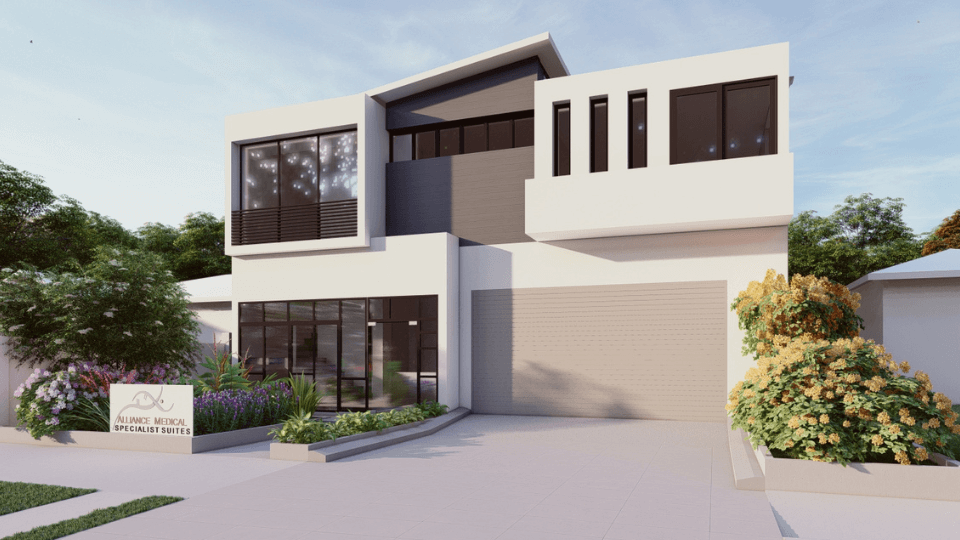
For a medical centre DA in Lidcombe (NSW), we flagged residential zoning and parking as the key risks for Council Rejection.
To overcome this risk, we carried out a complete site assessment and designed a scheme with generous on-site parking and allowances for surgical-waste management.
This proactive approach helped the application move smoothly through the assessment and ultimately resulted in an approval.
To see more of our case studies, click below.
Required Documents & Supporting Reports
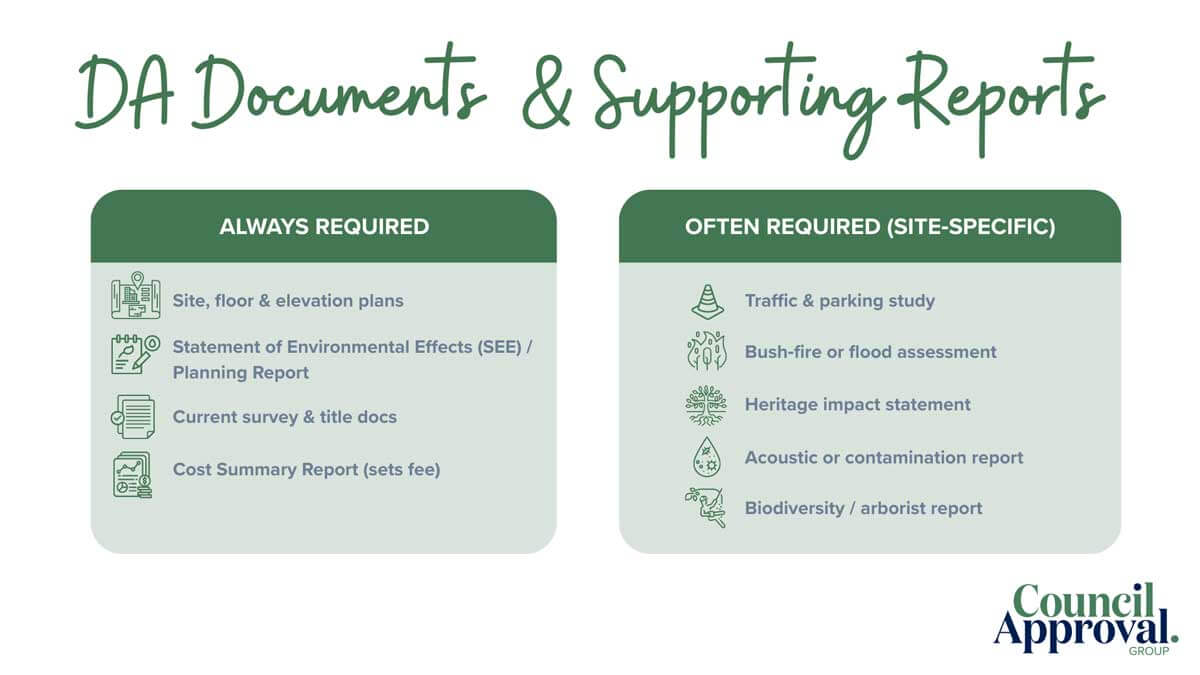
Not all DAs require the same documentation. Each application will require different reports to receive approval.
At Council Approval Group, we ensure that each project is tailored to include only the reports that your Council expects.
This way, we avoid gaps and wasting money on unnecessary reports.
5 Common Mistakes to Avoid & How to Fix Them
They are the blind spots that we see thousands of people make every day of the week and we will make sure that you don’t make those same mistakes – Colin Fragar
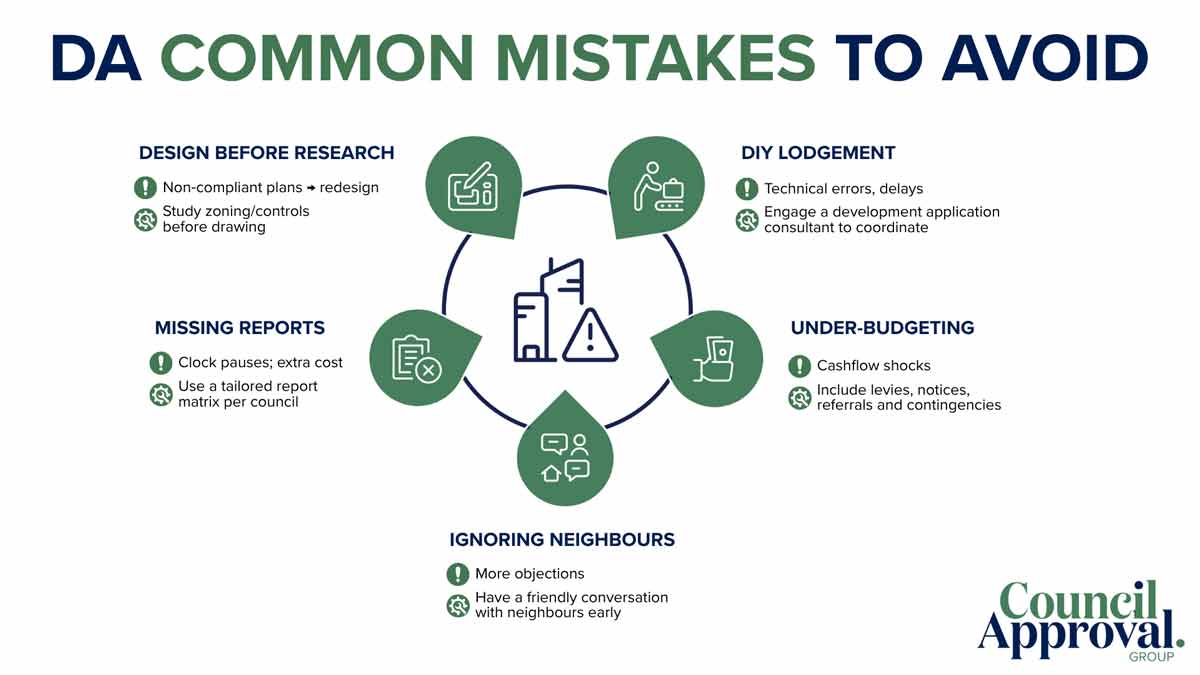
1. Design Before Research
Why it hurts: Jumping into plans without an understanding of the rules and zoning requirements can result in designs that may not be compliant.
Having non-compliant designs means you could end up paying double for plans and stalling your project.
Our Fix:
- Check zoning and read the LEP/DCP (or Planning Scheme) first
- Sketch a concept that fits the controls or has a clear, justified variation (include a backup option)
- Chat to a Town Planner early to confirm any red flags and check feasibility
2. Missing Reports
Why it hurts: Some councils may not even accept your application if the required reports are not included.
If your application is accepted, the clock will stop while you pay rush fees for consultants.
The way to reduce the probability of that getting rejected is to have a properly prepared application. Here at the Council Approval team, we have, literally, team members who used to work for council preparing your application because I know what’s going to occur at the front counter – Colin Fragar
Our Fix:
- Make sure you understand which reports are required
- Use a tailored report matrix for your council and project type
- Make sure reports match the latest plans
- Upload clean PDFs with correct scales and titles to avoid portal rejections
3. Ignoring Neighbours
Why it hurts: Neighbour concerns can snowball into delays due to objections and extra conditions for your project.
Our Fix:
- Have a friendly conversation with neighbours before lodgement
- Share easy-to-understand visuals (e.g., overshadowing and parking layout)
- Offer practical tweaks where reasonable
- Keep a short note of discussions, as this will be helpful if questions arise
4. Under-Budgeting
Why it hurts: If you don’t understand what the costs are, you may be in for a shock. Projects stall when unplanned costs appear (e.g., redesigns).
Our Fix:
- Include council fees, notification costs, referral fees, long-service levy, and developer contributions in your budget
- Allow a contingency for design changes
- It is a good practice to overestimate slightly
- Map when each cost is due, so cash flow stays on track
5. DIY Lodgement
Why it hurts: Small portal mistakes (e.g., wrong scales or filenames) could result in your application not being accepted into the portal, or could trigger requests for more information.
Our Fix:
- Engage a development application consultant to coordinate plans, reports and the Statement of Environmental Effects / Planning Report
- Follow a portal checklist: correct scales, north points, titles, signatures, and consistent filenames
- Submit a complete, coherent pack so the assessing planner can quote your reasoning instead of asking for it
DA Client Reviews
We had a difficult submission to put together for a planning permit. We got on board with council approval group. They held our hand and guided us to create the best possible submission. Very happy with the ladies we worked with and would highly recommend spending the extra money and getting them to help you get your permits submitted.
Colleen Cervi
I had an issue with my property in Vic and contacted companies and law firms to resolve it. They asked huge amount of money. But finally I got the job done by Council Approval Group with low cost and very fast time.
Kevin White
My family are eternally grateful to Council Approval Group for their interaction on our behalf in obtaining the council approval we needed in order to sell our property. They were supportive, professional and accurate, and successful!
Bronwen Heser
DA Timeframes (How Long Does a DA Take?)
The timeframe from lodgement to receiving an approval can vary greatly, and each Council is different. Much will depend on the Council’s current volume, but well-prepared applications beat average timeframes.
Timeframes can also be state-specific.
NSW
In the NSW Statement of Expectations Order from 2024, the Planning Minister expects Councils to deliver an approval within 105 days from submission for a DA to receive an approval from 1 July 2025.
Estimated times are expected to drop to 95 days in 2026 and 85 in 2027.
South East QLD
In South East QLD, the entire process currently takes 40 days from lodgement of the application for approval.
There can, however, be delays if the application does not meet conditions for approval.
VIC
Planning permits in Victoria vary greatly and depend on the application type.
At the time of writing, the current average time for a decision on an application in 2025 is 134 calendar days and 31 calendar days for a VicSmart Application.
Timeframes adjust, but you can view the current times in the Planning Permit Activity Reporting System.
Development Application Costs and Fees (How they work)
Some people decide to DIY their DA; however, this could cost you more in the end, due to delays caused by incomplete submissions or non-compliant plans lacking sufficient supporting evidence for approval.
In terms of the costs for a Town Planner, this largely depends on the type of development you are seeking.
Council fees for DAs and Planning Applications vary across Australia’s different states and councils.
Application fees also depend on the development type, complexity of the project, and the cost of works (the average expected cost of development).
NSW
DA’s in New South Wales are based on a scaling system of the Estimated Development Cost (EDC) for a proposed development and set as fee units, which are capped by the Environmental Planning Assessment Regulation 2021 and adjusted annually.
EDCs are calculated by including all associated costs, including demolition, construction and possible infrastructure changes.
Some developments require you to submit an EDC including GST, while others exclude GST. To be safe, it is recommended to supply the Council with both estimations.
EDCs below $100,000 can be calculated by the applicant. Anything over $100,000 requires a professional assessment.
Each Council has a separate fee structure, and some have a calculator to help with fee estimation, but the Council will notify you of the exact fee upon submission.
South East QLD
In Queensland, DA fees are dependent on the development category and size of development :
- Material change of use (MCU) – for example, a shop to a medical centre
- Reconfiguring a Lot (ROL) – for example, a subdivision or a change of boundary
- Operational Work (OPW) – Work which affects how the property is used, except for plumbing or drainage
- State Assessment and Referral Agency (SARA) fees may also apply if a Schedule 10 (involving state interest such as roads, vegetation heritage, etc.) trigger applies and is indexed annually
- Impact assessment applications also require public notification fees
The state mapping tool will help you to see triggers and estimate cost, but the Council will notify you of the exact amount upon lodgement.
What is a BASIX Certificate, and Do I Need One?
BASIX (Building Sustainability Index) is the NSW Government’s minimum standard for sustainability measures of new homes, large renovations (with cost estimates over $ 50,000) and pools/spas containing more than 40,000 litres.
Not all DAs or CDCs require a BASIX certificate, but they are valid for three months and, if needed, must be included with your application.
Before an Occupation Certificate can be issued, a certifier must issue a BASIX completion receipt to confirm that you complied with the development approval.
BASIX certificates were introduced to reduce resident bills and ensure homes are built for efficiency and comfort for:
- Thermal Performance – Nationwide House Energy Rating Scheme (NatHERS) 7 stars for heating and cooling loads
- Energy – Reduction of greenhouse gases via efficient systems or renewables
- Water – Fixtures, rainwater use, and pool or spa sizes
- Materials – Thermal performance and emissions
DA Public Notice & Decision (Can Neighbours Stop Your Project?)
Many people are concerned about neighbours impacting whether their plans are approved or not.
It is important to know that although neighbours do have a say, if your development isn’t against any of the planning rules and you supply sufficient supporting evidence through expert reports, neighbours will not be able to stop your project.
What if my DA is Refused?
If your DA is refused, it does not mean you have necessarily reached the end of the road. There are other options you may want to explore, such as:
- Revise your application and resubmit it
- Request a Section 8.2 review (This is a request to have the Council rethink the decision of your application, before you take further action in the form of an appeal to the Land & Environment Court (LEC)
- Appeal to the LEC
Can I Change My Design After Approval?
No, once approved and conditions are accepted, you cannot make changes to your design. If you do want to make changes, you can apply for a modification to the original consent.
Below, we share more information on how to apply for minor modifications.
After Approval: Conditions, Modifications & Tracking
Approval Conditions of Consent
A Development Approval often comes with conditions of consent. Approval conditions must be met to receive a Building Permit/Construction Certificate and to occupy the dwelling (Occupation Certificate), and some may come at an additional cost.
Only agree to conditions if you are fully satisfied that they are workable.
Approval Modifications
If you perceive the conditions to be unreasonable, it is possible to seek modifications. All modifications must be approved before development.
Modification Applications in NSW
To apply for minor modifications in New South Wales, Section 4.55 of the EP&A Act is required.
Section 4.55 must detail the changes (and may require a report), which cannot be too different from the original application. If changes are deemed too different to the original approval, a new DA will be needed.
Modification Applications South East QLD
If the changes to a DA are considered minor (a building that is not completed or deemed substantial by Planning & Building Control), you will need to submit a Change Application (sometimes called a Modification Application).
Minor changes don’t take too long to be processed.
For more significant changes, you will need to submit either an Other Authority Works (OAW – changes near infrastructure) change application or a Material Change of Use (MCU – changes that involve a new use or abandoned use) application.
Modification Applications VIC
To apply for a modification in Victoria, you should apply to the Council that issued the approval.
To do this, you can apply for a Secondary Consent Amendment (if the changes are minor) or a Section 72 Amendment if the changes are more complex (this change process is similar to a new application and will require supporting documentation).
Track Status Online
To see the status updates and key dates in NSW, you can use the NSW Application Tracker. If your property is located in QLD or Victoria, you can go to the relevant Council’s portal.
Why Choose Council Approval Group for Your DA?
2,000 + Approvals & Counting:
From backyard granny flats to regional shopping centres, we have the breadth of experience to help you with your project. Our approvals are frequently 4-8 weeks faster than the listed council averages.
We are a family-run business and have helped 50,000+ people during our 30+ years in business.
Ex‑Council Planners on Staff:
Having this background knowledge gives us the edge as we understand how Council officers think and draft conditions, so applications and responses are submitted according to their expectations.
One‑Stop Shop Serving Multiple Locations
Our In‑house Town Planners work alongside our Architect to ensure the highest chance of success. We are currently servicing clients across New South Wales, Victoria and South East Queensland.
Conclusion
Securing Council Approval with a Development Application, or Planning Application, can feel like threading a needle through layers of state legislation, local policy and community opinion.
Yet, with a clear strategy, the right professional team by your side and early council engagement, the process turns from multiple roadblocks to a roadmap.
At Council Approval Group, our Town Planners, Architects, and Property Consultants live and breathe DAs every day.
Whether it’s a dual occupancy, subdivision, or perhaps a new home, or any one of our other specialities, we would love to help you turn your property dreams into reality.
To start the process, click the button below and book a free consultation. Let’s make your project happen, minus the rabbit holes.
Article Last Updated: 8 September 2025